Answer Engine Optimization · ChatGPT, Perplexity & Gemini
Your buyers don’t scroll ten blue links anymore — they ask AI what to buy. Seenwise measures whose name comes back, finds out why it isn’t yours, and repairs it. Every week.
The new front page
When the answer names three tools and yours isn’t one of them, there is no page two. You don’t rank lower — you don’t exist. And it’s happening in conversations you can’t see.
What we measure
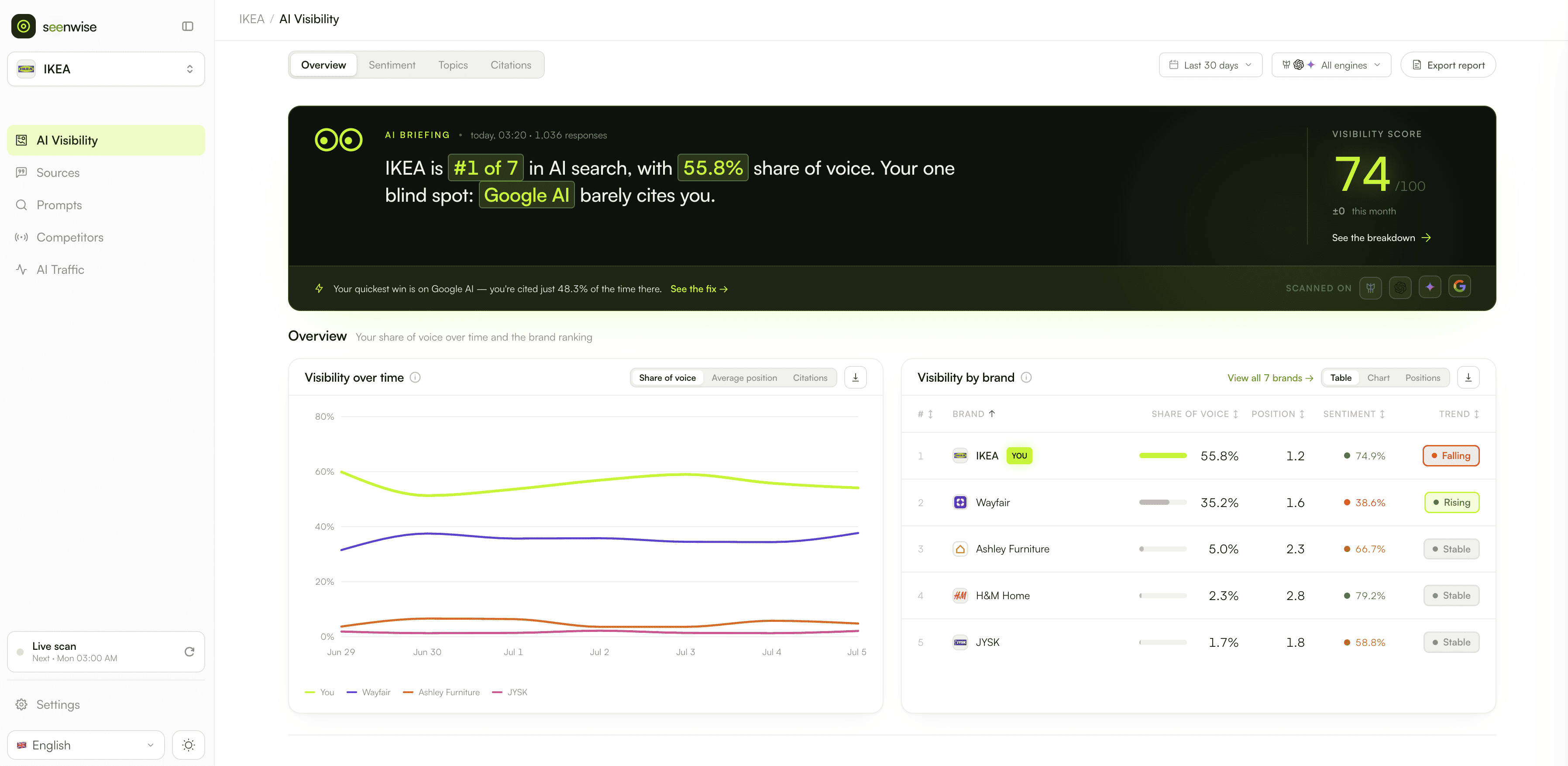
How often AI names you
0
%
[38–54%]The share of AI answers that mention your brand, across every prompt, engine and market — always with a confidence range, never a vanity number.
What AI reads about you
Engines don’t trust your site — they trust what others publish about you. We trace every answer back to the pages it quotes.
Where you exist — and where you vanish
The same brand can be everywhere on Perplexity and invisible on ChatGPT. Each engine reads different sources — so each needs a different fix.
How it works
01 · SCAN
Up to 50 buying-intent prompts, generated from your site, asked across ChatGPT, Perplexity and Gemini — in your language, in your markets.
02 · DIAGNOSE
Every answer is traced back to its sources. We see exactly which listicles, threads and rival pages the engines quote instead of you.
03 · FIX
Comparison pages, listicle outreach, schema markup — drafted and queued for your sign-off. Approve, and it ships.
Publish “Best PM software for small teams” — built to be quoted
Targets your #1 absent prompt. Structured comparison table + FAQ schema, written in the phrasing the engines use.
04 · MONITOR
Weekly re-scans, a report in your inbox, and an alert the moment a competitor takes a prompt that was yours.
Studiomatic overtook you on “agency PM software” — fix queued.
Publish “Best PM software for small teams” — built to be quoted
Targets your #1 absent prompt. Structured comparison table + FAQ schema, written in the phrasing the engines use.
Studiomatic overtook you on “agency PM software” — fix queued.
And everything around it
Weekly re-scans
Every prompt, every engine, re-tested on schedule. Trends, not snapshots.
Client-theft alerts
The moment a competitor takes a prompt that was yours, you know.
Action queue
Fixes arrive drafted — comparison pages, outreach, schema. You approve, it ships.
Weekly report
A plain-language update in your inbox: what moved, what shipped, what’s next.
Markets & languages
Geo-specific phrasings in the language your buyers actually use with AI.
Per-prompt diagnostics
Mention rate with confidence ranges, cited sources and verdicts — per prompt, per engine.
What changes
Your AI visibility becomes a number.
Then the number starts moving.
“cheap project management software” — 0% to 71% mention rate after one comparison page shipped.
Cited on Perplexity for small-team queries where the brand was invisible a month earlier.
From the field
We thought we had an SEO problem. We had an AI problem — ChatGPT was recommending our competitor by name. Six weeks later, we’re in the answer.
The weekly report reads like an update from an employee. I approve two actions on Monday and watch the number move by Friday.
We run AEO for fourteen client brands. The theft alerts alone justify the subscription — we hear about lost prompts before the client does.
Pricing
Every plan starts with the free preview scan. Subscribe and the full scan runs the moment you do.
What is Answer Engine Optimization?
SEO got you ranked in a list of links. AEO gets you named in the answer. When buyers ask ChatGPT, Perplexity or Gemini what to buy, the engine composes one response from sources it trusts — AEO is the practice of measuring whether you’re in that response, and fixing it when you’re not.
How does the free audit work?
Enter your domain. We read your homepage, draft your brand profile, topics and buyer prompts for you to review, then run a free preview scan — a sample of your prompts across all three engines. You see a real (if rough) share-of-voice estimate and who’s being cited instead of you. The full scan runs when you subscribe.
Where do the prompts come from?
Generated from your site: your category, products, markets and language produce up to 50 buying-intent prompts grouped by topic. You review every one before anything runs — edit, delete, or add your own. They’re your prompts, not a generic keyword list.
Which engines do you cover?
ChatGPT, Perplexity and Gemini, each sampled multiple times per prompt in your markets. Engines disagree wildly — being strong on one and absent on another is the norm, which is why we report them separately.
Will the agent publish things without my approval?
No. The agent drafts — comparison pages, listicle outreach, schema markup, community answers — and queues everything for your sign-off. Nothing ships until you approve it. On the Scale plan you can grant standing approval for specific action types.
How is Share of Voice measured?
Each prompt is asked multiple times per engine; we record whether your brand is named or cited. Share of voice is the mention rate across all samples, always shown with a confidence interval — AI answers are probabilistic, and a single query proves nothing.
Does this replace SEO?
It compounds it. Answer engines quote the same listicles, reviews and community threads your SEO work targets — but they weigh them differently. Your existing content becomes raw material; we find the gaps engines actually care about.
How fast will I see movement?
Citation-level fixes (schema, listicle inclusion, community answers) often register within one or two weekly scans. Net-new comparison pages typically take a few weeks to be picked up. The honest answer: it varies by engine — which is exactly why we measure weekly instead of promising.
Free preview scan · 2 minutes
Enter your domain. We’ll ask the engines the questions your buyers ask — and show you whose name comes back.